|
**CRATE TRAINING**

Introduction
Providing your puppy or dog with an indoor kennel crate can satisfy
many dogs' need for a den-like enclosure. Besides being an effective housebreaking
tool (because it takes advantage of the dog's natural reluctance to soil
its sleeping place), it can also help to reduce separation anxiety, to
prevent destructive behavior (such as chewing furniture), to keep a puppy
away from potentially dangerous household items (i.e., poisons, electrical
wires, etc.), and to serve as a mobile indoor dog house which can be moved
from room to room whenever necessary.
 A
kennel crate also serves as a travel cabin for you dog when traveling by
car or plane. Additionally, most hotels which accept dogs on their premises
require them to be crated while in the room to prevent damage to hotel
furniture and rugs. A
kennel crate also serves as a travel cabin for you dog when traveling by
car or plane. Additionally, most hotels which accept dogs on their premises
require them to be crated while in the room to prevent damage to hotel
furniture and rugs.
Most dogs which have been introduced to the kennel crate while still
young grow up to prefer their crate to rest in or "hang-out" in. Therefore
a crate (or any other area of confinement) should NEVER be used for the
purpose of punishment.
We recommend that you provide a kennel crate throughout your dog's lifetime.
Some crates allow for the removal of the door once it is no longer necessary
for the purpose of training. The crate can be placed under a table, or
a table top can be put on top of it to make it both unobtrusive and useful.
Frenchie Babies sleeping in their crate in
thier PlayPen area... all our babies are used to crates.... This was a
plastic crate we used for young babies... As you see it does not have a
door and these puppies are in our Expen Set up. We do not use plastic crates
anymore, but even when we did, we never had a door on them. Only used these
to keep the babies warmer while in their expen set up because they are
enclosed as opposed to all open as the wire crates, but the babies started
chewing on the plastic crates... it's what puppies do... So we threw out
the plastic type crates and we switched to wire crates for ALL ages and
they work best. If they get cold in the wire crate you can always cover
it with a blanket or towel....

Preparing the Wire Crate/Ex Pen area:
This baby has a crate attached
to the ex pen, a bed outside of the crate (where he is sleeping in the
photo), toys, bowls and a pee pad....

Furnishing Your Puppy's Crate
Toys and Treats: Place your puppy's favorite toys and dog treats
at the far end opposite the door opening. These toys may include the "Tuffy",
"Billy", "Kong", "Nylabone" or a ball. Toys and bails should always be
inedible and large enough to prevent their being swallowed. Any fragmented
toys should be removed to prevent choking and internal obstruction. You
may also place a sterilized marrow bone filled with cheese or dog treats
in the crate.
Water: A small water bowl with ice water should be attached to
the crate door if your puppy is to be confined for more than two hours
in the crate.
Bedding: Place a towel or blanket inside the crate to create
a soft, comfortable bed for the puppy. If the puppy chews the towel, remove
it to prevent the pup from swallowing or choking on the pieces. Although
most puppies prefer lying on soft bedding, some may prefer to rest on a
hard, flat surface, and may push the towel to one end of the crate to avoid
it. If the puppy urinates on the towel remove and replace with clean bedding.
It's a process and takes time.
When we first wean our babies from mom they are right in our living
room in a kiddie pool. They stay in this set up until they are ready for
their PLAY PEN (EXPEN) Set Up... which is a playpen with a crate attached
to it. Our puppies KNOW what a crate is when they go to their new homes.
We do NOT confine our young babies EVER to a crate with the door closed.
We use a playpen. Below is one litter in a kiddie pool set up while away
from mom. We no longer use these plastic style crates, but decided to leave
the photo here....

Location of Crate
Whenever possible, place the crate near or next to you when you are
home. This will encourage the pup to go inside it without his feeling lonely
or isolated when you go out. A central room in the apartment (i.e.: living
room or kitchen) or a large hallway near the entrance is a good place to
crate your puppy. If you use the set up we use here, your puppy will already
be used to sleeping inside a wire cage. Just needs to get used to being
along and away from it's littermates once it goes to its new home.
Some pups may howl or cry, but give them time,
they will get used to it.... DON'T GIVE IN.... hard... but a must....

Introducing the Crate to Your Puppy at your home....
In order that your puppy associate his/her kennel crate with comfort,
security and enjoyment, please follow these guidelines:
-
Feed him in the crate/playpen area, it's what they are used to here.
-
In the beginning, praise and pet your pup when he enters. Do not
try to push, pull or force the puppy into the crate/new set up at your
home. At this early stage of introduction only inducive methods are
suggested.
-
You may also play this enjoyable and educational game with your pup or
dog: without alerting your puppy, drop a small dog biscuit into the crate/playpen.
Then call your puppy and say to him, "Where's the biscuit? It's in your
room." Using only a friendly, encouraging voice, direct your pup toward
his crate. When the puppy discovers the treat, give enthusiastic praise.
The biscuit will automatically serve as a primary reward. Your pup should
be free to leave its crate at all times during this game. Later on, your
puppy's toy or ball can be substituted for the treat.
-
It is advisable first to crate your pup with the door closed for short
periods of time while you are home with them. In fact, crate training
is best accomplished while you are in the room with your dog. Getting
him used to your absence from the room in which he is crated is a good
first step. This prevents an association being made with the crate and
your leaving him/her alone. Again, this is why we use our expen set ups...
they have more room and are not confined to a small cage.
 
A Note About Crating Puppies
Puppies under 4 months of age have little bladder or sphincter control.
Puppies under 3 months have even less. Very young puppies under 12 weeks
should not be crated with the door closed, as they need to eliminate very
frequently (usually 8-12 times or more daily). Why we use our expen set
ups.
Important Reminders:
-
Collars: Always remove your puppy or dog's collar before confining
in the crate. Even flat buckle collars can occasionally get struck on the
bars or wire mesh of a crate. If you must leave a collar on the pup when
you crate him (e.g.: for his identification tag), use a safety "break away"
collar.
-
Warm Weather: Do not use plastic type crates for French Bulldogs.
They can overheat in them. Frenchies get hot very easily so wire cages
are the best for them.
 Be
certain that your puppy has fully eliminated shortly before being crated.
Be sure that the crate you are using is not too large to discourage your
pup from eliminating in it. Rarely does a pup or dog eliminate in the crate
if it is properly sized and the dog is an appropriate age to be crated
a given amount of time. If your pup/dog continues to eliminate in the crate,
the following may be the causes: Be
certain that your puppy has fully eliminated shortly before being crated.
Be sure that the crate you are using is not too large to discourage your
pup from eliminating in it. Rarely does a pup or dog eliminate in the crate
if it is properly sized and the dog is an appropriate age to be crated
a given amount of time. If your pup/dog continues to eliminate in the crate,
the following may be the causes:
-
The pup is too young to have much control.
-
The pup did not eliminate prior to being confined.
-
The pup has gaseous or loose stools.
-
The pup drank large amounts of water prior to being crated.
-
The puppy or dog is experiencing separation anxiety when left alone. It's
part of being a puppy, they get lonely and have to learn it's okay to be
left alone.
-
The puppy can just be stubborn. Unfortuntalely some people want to say
ALL dogs will not eliminate where they sleep.... NOT TRUE, this is why
we use the expen set ups. Some puppies are just stubborn or some just do
not care to pee or poop in a crate until they get older. Not all dogs are
the same, we can't paint them all with the same brush. Patience and
time are what is needed when raising a puppy.
Note: Puppies purchased in pet stores, or puppies which were
kept solely in small cages or other similar enclosures at a young age (between
approximately 7 and 16 weeks of age), may be harder to housebreak using
the crate training method due to their having been forced to eliminate
in their sleeping area during this formative stage of development. This
is the time when most puppies are learning to eliminate outside their sleeping
area. We use our expen set ups with our litters and they learn to potty
away from their crate/blanket area.
Accidents In The Crate:
If your puppy messes in his crate while you are out, do not punish him
upon your return. Simply wash out the crate using a pet odor neutralizer
(such as Nature's Miracle ir plain White Vinegar & Water in a spray
bottle). Do not use ammonia-based products, as their odor
resembles urine and may draw your dog back to urinate in the same spot
again.
Our girl Tazyy .... she was 100% crate and
potty trained in an oversized, crate/cage. These are fine as long as the
dog is crate and potty trained. If I have to leave them in a crate, I prefer
to give them lots of room, rather than not enough.

The Crate As Punishment
NEVER use the crate as a form of punishment or reprimand for your puppy.
This simply causes a young puppy to fear and resent the crate. If correctly
introduced to his crate, your puppy should be happy to go into his crate
at any time. You may however use the crate as a brief time-out for your
puppy as a way of discouraging nipping or excessive rowdiness.
[NOTE: Sufficient daily exercise is important for healthy puppies and
dogs. Regular daily walks should be offered as soon as a puppy is fully
immunized.
Barking In The Crate
In most cases a pup who cries incessantly in his crate has either been
crated too soon (without taking the proper steps as outlined above) or
is suffering from separation anxiety and is anxious about being left alone.
Some pups may simply under exercised. Some breeds of dog may be particularly
vocal (e.g., Miniature Pinchers, Mini Schnauzers, and other frisky terrier
types). These dogs may need the "Alternate Method of Confining Your Dog",
along with increasing the amount of exercise and play your dog receives
daily.
When Not To Use A Crate
Do not crate your puppy or dog if:
-
Puppy has not eliminated shortly before being placed inside the crate.
(See Housetraining Guidelines for exceptions.)
-
Puppy has not had sufficient exercise, companionship and socialization.
Buying a Wire Crate:
Where to buy a crate: Crates can be purchased through most pet supply
outlets, through pet mail order catalogs and through most professional
breeders. Check Ebay also, they sell new wire cages at great prices. We
use the 30" one for our adults. Plenty of room in those.
The Cost of A Crate:
Crates can cost between $35 and $150 depending on the size and the
type of crate and the source.
The Cost of Not Buying a Crate:
The cost of not using a crate:
-
your shoes
-
books
-
table legs;
-
chairs and sofas;
-
throw rugs and carpet, and
-
electric, telephone and computer wires.
-
The real cost, however, is your dog's safety and your peace of mind!!!

Alternative Method Of Confining
Your Puppy :
****THE METHOD ALL STAR PREFERS***

EX PENS. These are great alternatives to crates. They are open,
portable and bigger than crates. You can shape them in different shapes,
make them bigger, smaller and they aren't as confining, no top, so make
sure you don't have a high jumper or get the tall 4 ft ones... This is
the setup we prefer... We make sure the floor is not carpet, we set up
an expen, with crate in one corner, toys, water bowl, tray with puppy pads/newspaper
to one side. It's the best method we feel for the pups instead of crating
very young puppies or puppies who must be left alone in the house for lengths
of time.
You can also Use a small to medium-sized room space such as a kitchen,
large bathroom or hallway with non- porous floor. Set up the crate on one
end, the food and water a few feet away, and some newspaper several feet
away. Confine your puppy to this room or area using a 3 ft. high, safety-approved
child's gate rather than shutting off the opening by a solid door. Your
pup will feel less isolated if it can see out beyond its immediate
place of confinement. Puppy proof the area by removing any dangerous objects
or substances. We still prefer the Ex-Pen set up as seen here:
This is Lola, one of our puppies at her new
set up in her new home...
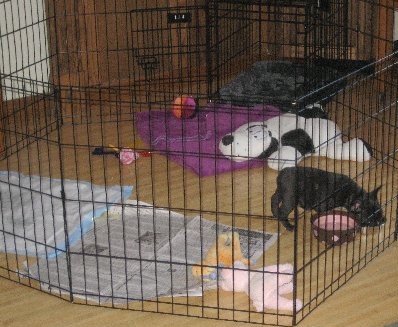
This is Casper, one of our puppies at his new
set up in his new home...

Lucy Lu in her set up at her new home...

Stella's set up... wire cage covered with towel to keep her warm...
Linoleum piece of flooring on top of area rug to make it sanitary and at
the same time warmer and softer, more cushy for the baby....
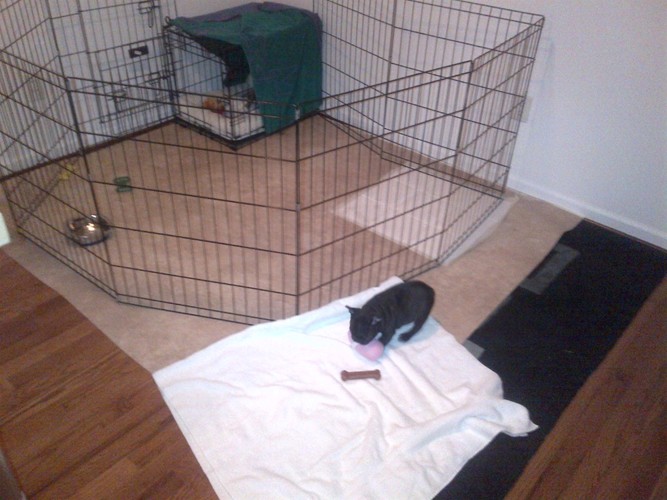
Buddha in his set up... Pee pad on the right side....

4x4 pen set up with crate, puppy pad "holder" on the right... an extra
bed pad outside of the crate and her bowl... this was a set up photo I
received before this "Frenchie Family" received their baby "Bella Bean"
from us.... this new mommy was prepared and ready for her baby....

Our methods are just that... our methods. Use what works for your and
your dog!!!
Ok, so we know Kennels/Crates are for going
inside, but some
Frenchies think they are Snoopy and like to
sleep/lay ON TOP, so there HA!...

OTHER LINK:
[IT’S
NOT A CAGE—IT’S A CRATE!]
Ask the Trainer by Magic Mildred
|







 Copyright©
All Star French Bulldogs
Copyright©
All Star French Bulldogs